A look at AI use cases in education organizations
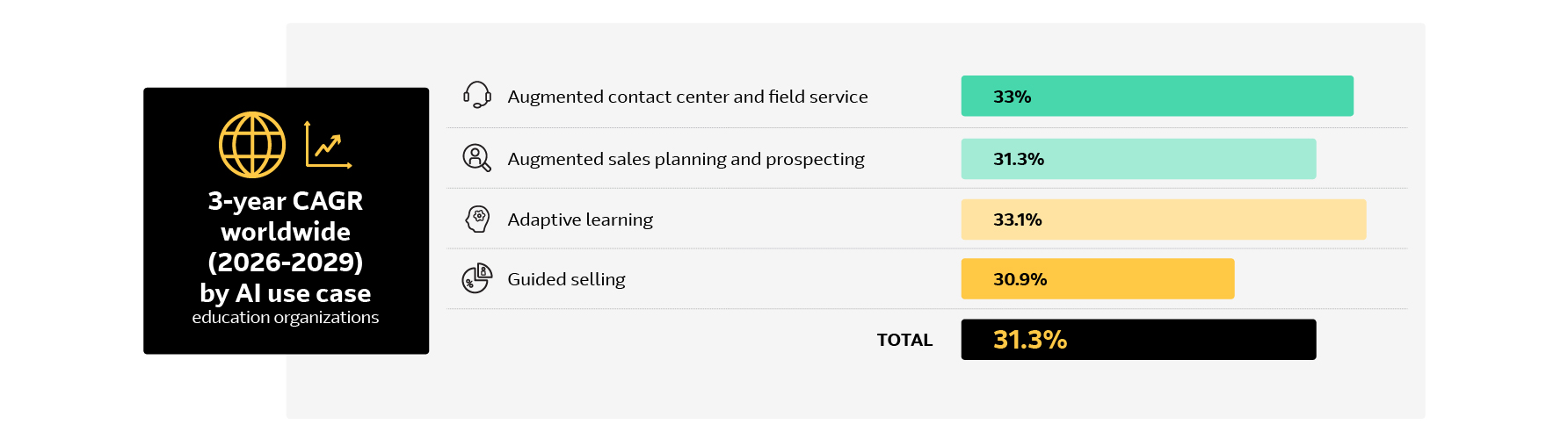
Globally, IDC projects education organizations will spend nearly $11 billion USD on AI use cases in 2026. With a three-year compound annual growth rate (CAGR) of 31.3%, worldwide spend on AI use cases in education is projected to reach $24.8 billion by 2029.1
As an AI technical solutions architect at Arrow, I see partners trying to support their customers' AI ambitions every day. In this article, I highlight some of the AI use cases that are among the top areas education customers are putting their money into.
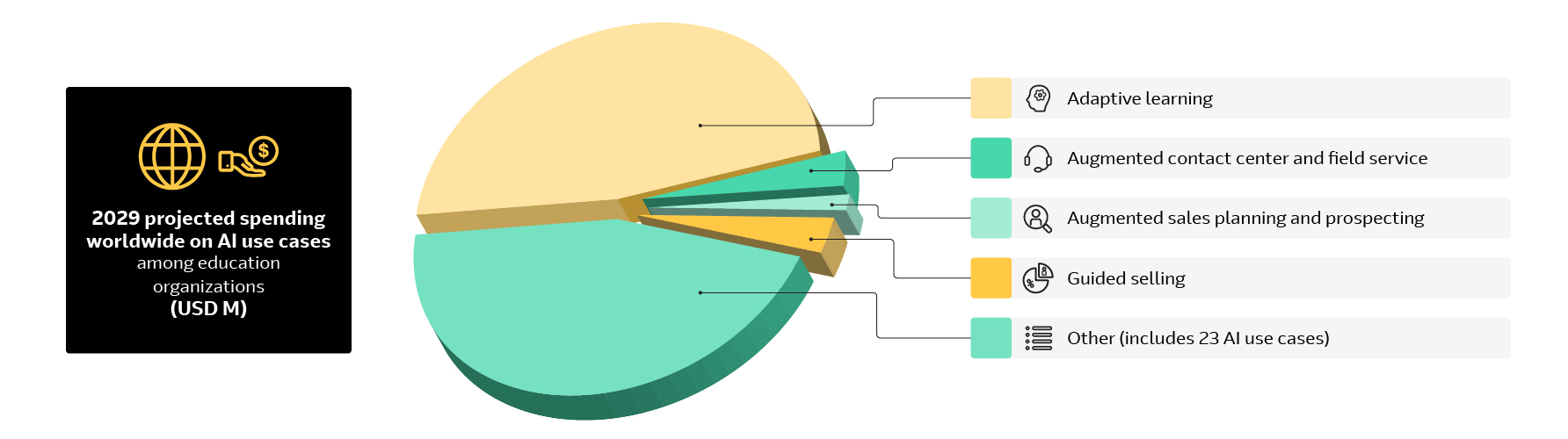
Let’s go into some of these use cases and why they could be worth exploring with any of your customers — even beyond the education space.
Augmented contact center and field service
IDC projects that the augmented contact centers and field service use case has a CAGR of 33% through 2029 among education organizations globally. These help organizations, including schools and universities, resolve issues faster across web, chat, phone and mobile. With intelligent voice response (IVR), multilingual support, and real-time call summarization — plus sentiment and next-best-action suggestions — agents can move from determining what happened to actually solving problems quickly, which matters when requests spike around enrollment, financial aid, registration, and IT outages.
Beyond the call center, field technicians can arrive with pre-visit summaries and full work history on their devices, while operations teams can track equipment usage, refills, and recurring fixes to standardize best practices. Over time, a centralized knowledge repository is maintained — including manuals, case studies, and technician know-how. This helps continuously improve how relevant answers are surfaced and where new articles should be created.
Nowadays it’s very common to see a chatbot embedded on a college website (or at any organization outside of education for that matter), and partners are often packaging this as a tailored solution rather than a one-size-fits-all bot. Instead of a simple LLM wrapped, partners are making these chatbots more robust with built-in tools and custom knowledge bases. Our Azure team built a robust framework that allows users to communicate with voice and ask specific questions about the customer's organization. Request to see it now.
Augmented sales planning and prospecting
This use case allows organizations to turn forecasting, prioritization, and first-touch outreach into more data-driven, repeatable processes. Instead of relying on intuition alone, AI can analyze historical sales performance, customer preferences, and external signals. It can also evaluate multiple data sources, such as CRM and website engagement (e.g., clicks and time spent) to pinpoint high-value prospects and early churn risk, then trigger targeted marketing or sales actions based on those insights.
While IDC projects education organizations to spend 31.3% more on the planning and prospecting use case globally in the next three years, it’s another example that is certainly not exclusive to education organizations. I have seen a strong appetite for this use case firsthand, and we have demos aligned to this workflow that we can show partners to demonstrate the art of the possible and help accelerate AI sales cycles.
Adaptive learning
Adaptive learning is expected to grow by 33.1% globally among education organizations. This use case personalizes how content is presented based on each student’s performance — shifting with every interaction a learner makes in real time. What makes it especially attractive to K–12 districts is the promise of augmented learning: AI that supports homework and skill-building without simply giving the answers away, helping students stay engaged while preserving academic integrity. On the operational side, educators and staff could benefit, as this use case could include assistance with administrative efforts such as lesson planning and performance evaluations.
Demand for this use case is showing up in school districts. In fact, we’ve worked with a partner to complete a robust RFP for a large district. We designed a multi-agent orchestration platform to address the needs of students, teachers, facility staff and parents/guardians. If it’s of interest to your business, we are here to help support your RFP efforts and have multiple agentic demos to showcase.
Guided selling
With a global compound annual growth rate of 30.9% by 2029, guided selling is another industry-agnostic use case that is attractive to organizations including those in education. It expedites a traditionally heavy, document-driven buying cycle. Instead of starting from scratch each time, teams can generate proposals and outlines, respond to RFIs, and summarize RFP requirements while staying aligned and compliant to rules, standards and deadlines. It also supports the day-to-day reality of sales and partner motions by automating repetitive work, such as email templates and CRM updates, and producing more relevant outreach through personalized sales emails. On the buyer-facing side, it can recommend products based on purchase history, buying behavior, and stated preferences.
At Arrow, I’m seeing this show up strongly around RFIs and RFP response drafting and review, especially in the public sector.
Arrow’s technical experts can help you with all of these use cases — or help you discover new ones. Request a meeting with our technical team or visit our AI webpage to learn more about our AI capabilities.
1Source: IDC Worldwide AI and Generative AI Spending Guide - Forecast 2026 | Mar (V1 2026)
Featuring top AI vendors like: