


Love it or hate it, the tail has wiggled its way on stage. With all the interesting bots on this season of BattleBots, Caustic Creations wanted to add something to our bot—Poison Arrow— that would be entertaining.
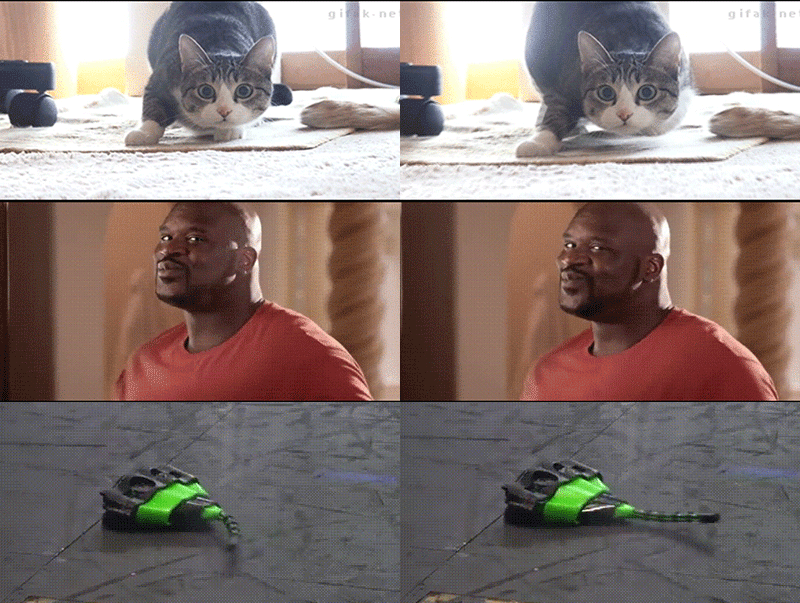
So what did they hope to accomplish? With the influx of meddler bots this season they wanted to add another dimension to the equation. The object of the tail is to provide an easy few points to the opponent in hopes they will lose focus on the main bot. The strategy is to drop the tail in front of the opponent and wait for them to take the bait. When they do, line up the perfect hit and win the match.

The tail is actually its own robot. It has four servos, a battery, and a receiver. Two servos are for moving the tail and two are for pulling release pins to drop the tail from the main robot. It is 3D printed from ABS, which made it easy to make lots of spare parts quickly. The plan was to lose a few tails in competition, so repairs had to be simple.

Once the tail was finished printing, Caustic Creations teammate Hana went to work sanding and painting. To fill large cracks in the print she used molding epoxy. Once that was done and the shells were sanded, each part received a coat of high build primer. This is commonly used in automotive painting and is great to fill in some of the rough edges of 3D printing.

Two tails were prepared for battle. If one got destroyed the other could be quickly swapped into the existing mechanisms so Poison Arrow could stay fighting.

The mechanics of the tail are super simple. There are two main servos that pull on two steel cables that actuate the tail. The cables are mounted in the end of the tail and are free to move through the length of the tail. By pulling on each wire you can force the tail to contract and move much like an animal’s tail. The pin actuators provide the option of releasing the tail from the main bot because above all else Poison Arrow can’t risk running over its own tail during a match and getting stuck. The pin latches are made from 3D printed plastic so they can break away if it is grabbed—much like a lizard’s tail breaks off so it can escape when caught.

You can see the cables exit the tail along with the spring "backbone" here. 3D printing allowed for the shells to be hollowed to remove weight and reduce printing time. Since a new tail might have to be built at any time, printing time has to be kept to a minimum.

Here is the full tail structure from the top. The backbone gets its support from the tubing. This tubing acts like the cartilage between bones. Adding more cables would give the tail more maneuverability but for simplicity’s sake a good wiggle motion works just fine.

Believe it or not, the tail addition almost didn't happen. With all the time constraints the tail was always at the bottom of the list. This is where having a great team makes all the difference. Hana and Nick stepped up to turn the tail from a crazy whiteboard concept into reality. Without them, Poison Arrow’s tail would still be on the drawing room floor.