

In targeting the Arm64 processor market for Windows 10 IoT Enterprise, Microsoft prioritized catering to distinct customer requirements and making necessary improvements based on feedback for the Windows 10 IoT Core operating system. Join me on this voyage and witness how Microsoft’s attentiveness to its customer base resulted in a winning approach.
Microsoft has supported Windows on Arm since 1996 with the release of Windows CE, which primarily targeted smaller devices like smartphones, handheld computers, and embedded systems. Windows CE continued until 2013, culminating in the final release called Windows Compact 2013. However, the real journey began in 2015 when Microsoft shifted its focus to a new product, Windows 10 IoT Core.
Despite Windows CE7 and Compact 2013 having several years of life left (2026 and 2028, respectively), original equipment manufacturers (OEMs) were eager for the next version of Windows CE. Instead, they were presented with Windows 10 IoT Core, which had some limitations. While it did support Arm32 processors like Qualcomm Snapdragon, NXP, and Raspberry Pi boards, it only worked with the Universal Windows Platform (UWP) and not Win32 apps. This restriction proved problematic as most OEMs preferred to transition their Windows CE Win32 apps to a newer product without the need converting or compile them into UWP apps. Another major drawback was the need for a GUI interface and the minimal driver support, further hampering the product’s adoption.
The other option was transitioning to the significantly larger and more costly Windows 10 IoT Enterprise lineup, which offered support for Win32 apps. However, this choice came with the drawback of requiring much more storage space and a notably higher price tag than Windows CE.
Another area for improvement with the no-cost Windows IoT Core operating system was the lack of comprehensive support. Support for IoT Core ceased in November 2020. Still, Microsoft provided an option to secure the 10-year Windows 10 IoT Core Services, transitioning the product from a cost-free offering to a $35 purchase, granting access to Long-Term Servicing Channel (LTSC) support. This extension prolonged the support timeline until January 2029 and fixed the build version at 1809, which marked the product’s final release. It is now officially retired.
The early editions of Windows 10 IoT Enterprise on Arm64 came with notable limitations. One of the critical drawbacks was the absence of an LTSC edition, resulting in a mere three-year support period compared to the 10-year support provided by LTSC versions. OEMs in the IoT channel typically steer clear of non-LTSC products as they require extended longevity and comprehensive support. Another source of confusion was part number selection – pricing and part numbers varied based on the Arm processor selection.
Windows 10 IoT Enterprise on Arm64
Stay with me as I guide you through the Windows IoT Enterprise products compatible with Arm64 processors, although it’s vital to note that its end of life (EOL) is October 31, 2023. While considering the Windows 10 Non-LTSC edition might need to be more logical, I aim to provide a comprehensive overview of the entire history of Windows IoT Enterprise on Arm.
We have two options for the Windows 10 IoT Enterprise on Arm64: NXP i.MX8 “BASE” Price Tier and Qualcomm Snapdragon 8cx “VALUE” Price Tier.
Contact For Quote Download the Hardware Guide
|
EOL |
EOS |
Part# |
Windows 10 IoT Enterprise SAC “BASE” Arm64 (NXP i.MX8) |
|
10/31/23 |
10/14/25 |
T1X-00007-1P |
Win 10 IoT Ent SAC Base Arm64 MultiLang ESD OEI |
|
10/31/23 |
10/14/25 |
T1X-00008-1P |
Win 10 IoT Ent SAC Base Arm64 MultiLang ESD OEI EPKEA |
|
EOL |
EOS |
Part# |
Windows 10 IoT Enterprise SAC “VALUE” Arm64 (Qualcomm) |
|
10/31/23 |
10/14/25 |
QHJ-00002-1P |
Win 10 IoT Ent SAC Value 64Bit Arm MultiLang ESD OEI EPKEA |
|
10/31/23 |
10/14/25 |
QHJ-00003-1P |
Win 10 IoT Ent SAC Value 64Bit Arm MultiLang ESD OEI |
Based on these dates, Windows 10 IoT Enterprise Arm editions not only reach EOL in October 2023, but their support ends in October 2025. They should not be an option at this time. Even if you were to utilize downgrade rights from Windows 11 IoT Enterprise, the support would still cease in 2025 – designing a product with just two years of support is not a recommended approach for OEMs. It’s always prudent to prioritize and opt for the LTSC editions, which I will delve into later in this blog.
Windows 11 IoT Enterprise Arm64
As of the time of this writing, Windows 11 IoT Enterprise Arm64 presents just one choice: the Qualcomm Snapdragon – Value-based Price Tier. On the positive side, this product boasts an extended lifecycle. However, its support is limited to three years per build version, a timeframe that doesn’t align well with the needs of most IoT OEMs. Additionally, it falls into the relatively expensive VALUE-based price tier, making it less suitable for Arm IoT devices. Its compatibility extends solely to Qualcomm Snapdragon 7c, 8c, 8cx, and 850. Given the expense and short support span, most OEMs are unlikely to base their product design on this option.
|
EOL |
EOS |
PART# |
WINDOWS 11 IoT Enterprise (Arm) Qualcomm |
|
12/31/31 |
Per Build |
QHJ-00019-1P |
Windows® 11 IoT Enterprise Value for Arm64 (ESD) ePKEA |
|
12/31/31 |
Per Build |
QHJ-00020-1P |
Windows® 11 IoT Enterprise Value for Arm64 (ESD) PKEA |
Windows 10 IoT Enterprise LTSC 2021 Arm64
The journey gets exciting with Microsoft’s introduction of the Windows 10 IoT Enterprise LTSC 2021 Arm64 version. This development brought pricing down to an acceptable level and tackled numerous customer requirements inherited from Windows CE. While its arrival might have been delayed, considering the extended support cycles of Windows CE6, CE7, and Compact 2013, the timing could be opportune. Many OEMs still engaged with CE devices find themselves at the juncture of designing their replacements, making it a perfect moment to consider Microsoft’s LTSC 2021 product.
Microsoft aimed to provide a solution catering to CE and small IoT device OEMs seeking high performance within a compact, cost-effective framework. Collaborating closely with NXP and other manufacturers, Microsoft curated impressive board packages, allowing OEMs to initiate their embedded and IoT device design by combining the board and processor, subsequently integrating Windows 10 IoT Enterprise LTSC on Arm64 complete with 10 years of support and operating their Win32 apps. Additionally, the operating system has streamlined storage and memory prerequisites reminiscent of the CE era.
The Windows 10 IoT Enterprise LTSC 2021 Arm64 offering exclusively supports the NXP i.MX8 processor family and, when positioned within the BASE price tier, make it remarkably affordable. Its extensive lifecycle stretches until 2031, and support continues to January 2032. Whether transitioning from CE or grappling with Linux distribution challenges, this downloadable product presents a comprehensive Windows 10 IoT Enterprise solution engineered for NXP Arm processors.
|
EOL |
EOS |
Part# |
Windows 10 IoT Enterprise LTSC 2021 “BASE” Arm64 (NXP i.MX8) |
|
11/30/31 |
01/13/32 |
UE8-00007 |
Win 10 IoT Ent LTSC 2021 Base Arm64 MultiLang ESD OEI |
|
11/30/31 |
01/13/32 |
UE8-00008 |
Win 10 IoT Ent LTSC 2021 Base Arm64 MultiLang ESD OEI EPKEA |
These boards support the LTSC 2021 product:
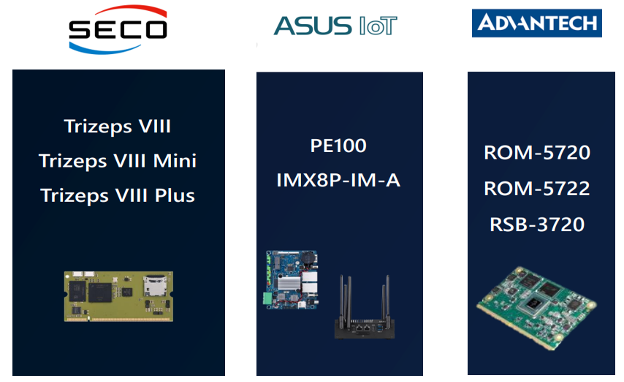
Arm architecture, known for its energy efficiency and performance, has become popular for embedded and IoT deployments. Windows 10 IoT Enterprise LTSC 2021 on Arm64 capitalizes on this architecture, enabling seamless integration with the NXP i.MX8 processor. Arm and Windows 10 IoT combine the best of both worlds, offering developers unparalleled performance, scalability, and power efficiency.
Microsoft has successfully adjusted its trajectory for smaller IoT and embedded devices and are now ready to invest in OEMs seeking long-term support. This alignment presents a remarkable synergy with Arm processors with extensive lifecycles.
If you want to start designing and testing a board with the Arm version, contact us here at Arrow windowsiot@arrow.com, and we will get you started on your Windows Arm journey.
