

.lumen and Arrow
How Arrow is helping .lumen
Arrow Electronics helps .lumen identify, source, and integrate the lengthy list of processors, cameras, sensors, and connectors required to create an intelligent wearable device.
With funding from the European Innovation Council and other investors, the company’s mission is to have blind people pay little or nothing for the glasses. They already have received 1,500 orders from blind Romanians who qualify for government assistance, via a Romanian assistive government program. For others, the cost will be around $10,000 USD.
The device is not yet commercially available, but pre-order updates are available on dotlumen.com.
.lumen’s innovative approach has been recognized globally, being named a CES Innovation Awards 2026 Honoree in the Accessibility and Longevity category, and winning the CTA Foundation’s 2026 Pitch Competition.
Arrow can support .lumen’s efforts to scale its production by providing engineering and supply chain services for inventory reliability, cost control, and improved performance.
“We are helping to create a device which eventually will make life better for millions of people affected by blindness worldwide,” said Vitali Damasevich, Arrow’s regional director of engineering in Eastern Europe.
Globally, the potential market is enormous: 43 million people worldwide are blind and 338 million have significant vision impairments, and the numbers are expected to grow significantly. And the opportunity for a breakthrough vision technology is apparent: only 28,000 blind people worldwide have service dogs. Training takes two years and costs as much as $75,000 USD. Most dogs fail the program.
“Technology is the only scalable solution to provide blind people with the mobility and freedom they need,” Amariei said. “Our glasses replicate the main features of a guide dog, without the huge cost or the maintenance.”
How it works
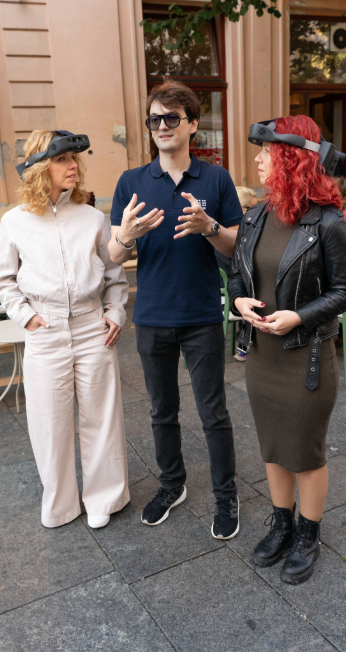
.lumen’s glasses combine artificial intelligence, computer vision, and stereo edge vision on a single wearable headset. Its durable, weather-proof wearable that sits comfortably across the forehead. It is powered by a rechargeable battery.
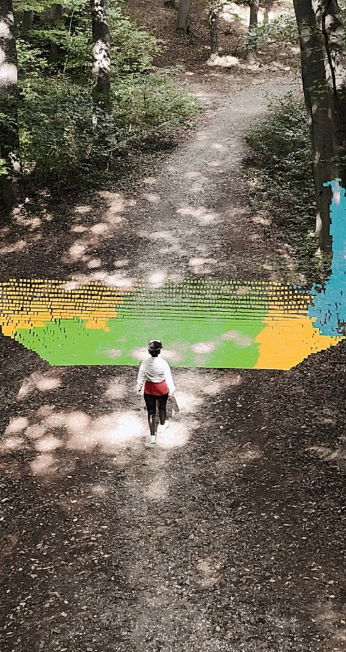
Using a proprietary navigation system called Pedestrian Autonomous Driving AI, the. lumen glasses integrate six cameras to observe the surroundings, much like how an autonomous car operates. Two of the cameras are color, and four are infrared in stereoscopic pairs.
The cameras detect:
- Ground-level obstacles (curbs, potholes, parked cars, scooters)
- Overhead dangers (branches, signs, window ledges)
- Hazardous and irregular surfaces such as puddles and mud
- Key landmarks such as pedestrian crossings, stairs, doors, and bus stops
The integrated view is sent to an NVIDIA vision engine. The module is loaded with a proprietary Pedestrian Semantic Segmentation ML Model, which processes the flow of visual data 100 times per second and contextually understands the view. The startup’s engineers regularly update the model for expanded functionality and improved accuracy.
The continuous analysis is not completed remotely in the cloud, but rather on the device itself. In this way, the glasses work on the intelligent edge.
Intelligent edge devices operate by generating and processing data at the source on the same platform rather than relying on centralized cloud computing.
This enables immediate decision-making based on real-time data analysis, whether by a robot on a factory floor, an autonomous vehicle on the street or, in the case of .lumen, a blind person walking across a busy street.
“We cannot risk the latency that can occur in communications between the Cloud and a remote device,” Amariei said. “When a person is crossing a street with cars and buses, our device must provide relevant information immediately and accurately.”
Helping the blind to navigate
In individuals who are blind, especially those who lost their sight later in life, the visual cortex typically is still active but the eyes and the neural connection to the brain are damaged. Imaging research shows this area repurposes to process non- visual sensory information, such as sound and touch, and may even contribute to spatial awareness and memory.
So Amariei and his team made the fateful decision not to whisper directions and warnings into the blind person’s ear. That’s because voice commands can be hard to distinguish, especially on noisy city streets. And people with vision impairments already rely on their sense of hearing far more than people with normal sight.
Instead, the glasses communicate mostly via haptic sensors. Haptics stimulate the sense of touch through vibrations, forces, or motions, adding a different level of detail to a person’s perception.
To avoid an obstacle, gentle vibrations indicate the safest route to advance. To find a safe path, the user feels an insistent pulse to the center of the forehead.
By stimulating the forehead area, the glasses generate specialized vibrations that change over time and space, creating the sensation that something is gently “nudging” your head in a certain direction.
Simply put: follow the vibrations
“Haptics are intuitive,” Amariei said. “We don’t want our instructions to be too complex and degrade the user’s perception of the situation.”Now that. lumen users can walk freely and avoid obstacles, the next step towards independent living is using the glasses to find specific locations and objects.
Find me
The startup is introducing a new feature called “Find Me.”
The “Find Me” feature combines visual understanding and spatial relations to help users find what they need. In this new application, .lumen is combining speech with its haptic instructions.
For example, a blind person enters a chilly hotel room and wants to adjust the temperature. Normally, it takes many frustrating minutes to find the thermostat in an unfamiliar environment.
The “Find Me” program is loaded with images of hundreds of common objects. As the user scans the hotel room, the headset’s cameras work to recognize the thermostat on the wall. Subtle haptic vibrations indicate where the user should turn. Getting closer, spatial sound tells user the distance and orientation.
“You no longer need to ask for help or touch everything,” Amariei said. “Simply say what you are looking for, and the technology helps you find it.”

Meet the testers
Andrea Nagy
Born in Hungary, the journalist and radio host is a recognizable figure in Cluj, Romania. She has been testing .lumen’s technology since its inception.–
Andrea’s motto: “I believe in being resilient. I am guiding myself.”
Alex Benchea
Alex is a passionate athlete, practicing endurance running, sprints and climbing. He is training to represent Romania and compete in the Paralympics Games.
Alex’s motto: “I want to go fast. I want to be as mobile and as free as possible.”
Irina Crocker and Silvia Stelea
The twins lost their eyesight in their 20s to an inherited condition. Irina works in insurance. Silvia is an entrepreneur and mother of two. They compete as Paralympic archers and serve as motivational speakers.
Their motto: “The technology makes our lives better. The feeling of freedom is absolutely priceless.”
About .lumen’s glasses for the blind
They understand obstacles and keep you away from them.
Indicate safe walking paths and avoid roads, puddles, or mud.
Compute 100 times a second where you can safely walk.
Tested by blind users in over 30 countries.
Haptic directions are gentle, consistent, and universally understood.
High-power, low latency, small size, ultra-fast and reliable.
What is semi-autonomous mobility?
.lumen’s expands Arrow’s concept of SAM technology for people with physical disabilities.
SAM stands for semi-autonomous mobility. More than a decade ago, Arrow recognized that intelligent technology can quickly make people’s lives better by providing more mobility.
With mobility comes freedom – and opportunity. Arrow has developed a series of advanced cars that a quadriplegic race driver controls with the help of an AI model and electronics developed by Arrow engineers.
The Arrow SAM Car differs from autonomous vehicles in that the driver is in full command of the car’s steering, acceleration, braking and other systems – at speeds up to 213 mph.
Arrow has expanded the SAM concept with new interactive applications. Arrow engineers modified an exoskeleton so people with high-level quadriplegia could resume walking. And in 2020-21, Arrow led the development of a social robot for people isolated by disabilities and illness.
.lumen’s proprietary glasses extend semi-autonomous mobility in important new ways.
It is the most advanced assistive technology worldwide for the blind. Secondly, it extends the SAM concept beyond paralysis to people with vision impairment. And finally, the technology is meant to be a viable commercial product manufactured at scale rather than a demonstration for social impact.