
Featured Blogs
Staying Ahead in a Tight Memory and Storage Market
July 2026
DRAM and NAND supply remains tight, and demand is still building. Arrow helps customers understand what’s changing, where options may be limited, and how to plan.
In our previous update, we outlined how the memory market had shifted from a traditional cycle into a more managed, allocation-driven environment. Since then, those dynamics have continued to develop.
Memory has become even more important to AI infrastructure, with more capacity moving toward higher-value products like HBM and DDR5. That shift can make conventional DRAM, legacy memory, and lower-density storage harder to source.
As AI use grows across more applications, customers may see supply continue to favor newer, higher-performance technologies.
Industry forecasts still point to growth across DRAM and NAND Flash, supported by AI adoption, higher-performance computing requirements, and enterprise storage needs. For customers, the takeaway is plan for supply access, approved alternates, and lifecycle transitions.
Long-term commitments, existing demand, and supplier priorities are shaping what customers can secure and when. As capacity shifts toward AI and newer technologies, some legacy and lower-density products may become harder to support.
That makes lifecycle timing, approved alternates, and technology transitions more important. Customers may need to decide when to move to current revisions, how long legacy products can realistically be supported, and where component flexibility can reduce risk.
What’s the Latest in Memory and Storage by Category
DDR5 DRAM
- Supply remains constrained, with server, DDR5, and AI-related applications continuing to take priority.
- Client and consumer segments may see tighter access as demand remains focused on higher-priority applications.
- Teams that rely on steady DRAM supply should confirm demand signals, approved alternates, and transition plans early.
DDR4 DRAM (Legacy Segment)
- DDR4 supply remains limited, especially for customers supporting industrial, embedded, and legacy platforms.
- Production remains selective, which can make consistent access challenging for long-running programs.
- For some customers, this may be the right time to look at DDR5 migration paths.
NAND Flash
- NAND supply remains closely tied to enterprise and AI-related demand.
- Legacy storage options may become more limited as the market shifts toward higher-capacity solutions.
- As suppliers move toward higher-layer NAND technologies, customers using older configurations should review lifecycle timing and alternative options.
HDD Market
- High-capacity HDDs continue to play an important role in cost-effective storage strategies.
- Demand for higher-capacity drives remains strong, while lower-capacity options may be less available over time.
- Customers with long-term storage requirements should review alternates and transition timing sooner rather than later.
How Arrow Helps Guide Customers Through This Market
As supply stays tight, Arrow works with customers to plan and make practical sourcing decisions. Explore the table below for how Arrow helps guide customers through this market.
| Area of Focus | Description |
| Broadening supplier options | Helping qualify new and underutilized suppliers so customers have more options when components are constrained |
| Sharing market visibility |
Providing insight into constrained parts, supply trends, and configuration choices so teams know what to expect |
| Exploring practical alternatives | Helping customers compare options that can support continuity and keep programs moving |
| Supporting DDR4 continuity and transition | Working with industrial, embedded, and legacy customers on inventory continuity, allocation-based supply, and DDR5 transition planning at a pace that aligns with their business needs |
| Using supplier relationships | Working with platform providers to help customers understand constraints and plan deployments in a changing market |
| Aligning supply with business priorities | Helping customers think through critical components, timing, and sourcing choices so they can avoid surprises and stay on track |
| Managing product lifecycle transitions | Enabling customers to plan for technology revisions, supplier roadmap changes, and end-of-life (EOL) considerations so they can qualify alternatives before options become limited |
Memory and storage conditions can change quickly. Arrow helps customers make sense of those changes, compare realistic options, and give teams more room to adjust when supply or technology direction shifts.
If your team is weighing supply options, planning a transition, or managing product lifecycle changes, Arrow can help you sort through the choices and decide what to do next.

Building Infrastructure Confidence in an Uncertain Supply Chain Climate
June 2026
The next several years will require more disciplined infrastructure and supply chain planning because memory, storage, and other component markets continue to evolve. For organizations building and scaling technology solutions, choosing the right platform is only part of the decision. Teams also need confidence that systems can be delivered consistently, configured predictably, and supported as market conditions shift.
With component availability, pricing, and deployment timelines in a continuous state of change, companies developing hardware-based solutions, software-defined platforms, edge appliances, embedded systems, and validated infrastructure offerings are asking practical questions earlier in the planning process:
- Can the systems be delivered when and where needed?
- Can configurations remain consistent across regions?
- Can suppliers respond to changing demand?
- Can costs be managed as component markets fluctuate?
- Can organizations move from prototype to production without unnecessary delay?
These questions are becoming a larger part of how organizations evaluate infrastructure partners.
The Business Impact of Supply Chain Uncertainty
When infrastructure availability changes unexpectedly, the impact can extend across product planning, delivery commitments, regional rollouts, margins, and lifecycle support. Teams may need to adjust validated configurations, revisit timelines, or manage cost changes that were not part of the original plan.
The added complexity is why supplier selection has become a more strategic infrastructure decision. Organizations need technology partners with the scale, visibility, and operational discipline to support planning, maintain consistency, and help execution stay on track as conditions change.
Supply Chain Assurance Starts with Proactive Planning
As organizations look for greater visibility and consistency in their infrastructure decisions, Lenovo offers a strong example of supply chain scale and discipline. Lenovo is ranked number eight in the Gartner Supply Chain Top 25 for 2025, demonstrating its ability to use a global, flexible, and resilient supply chain to navigate macroeconomic uncertainty.
That recognition is supported by practical planning measures, including working with component suppliers to forecast demand over the next 18 months and, where possible, making bulk purchases to support cost stability and supply continuity.
Lenovo’s supply chain strength is also reinforced by its global manufacturing footprint and continued expansion across key regions. Manufacturing growth in the Middle East, along with established operations across Latin America, North America, EMEA, and APAC, strengthens Lenovo’s ability to support customers across geographies and respond to changing demand.
The company is also aligning its supply chain strategy with high-growth technology areas, including AI and infrastructure solutions. This focus reinforces the importance of supplier coordination, planning visibility, and execution discipline as organizations prepare for changing infrastructure requirements.
Infrastructure Options from Edge to Enterprise
Lenovo’s portfolio spans compute, storage, edge, and end-user platforms, giving organizations a flexible foundation for different solution models and deployment environments.
[caption id="attachment_13702" align="alignnone" width="600"]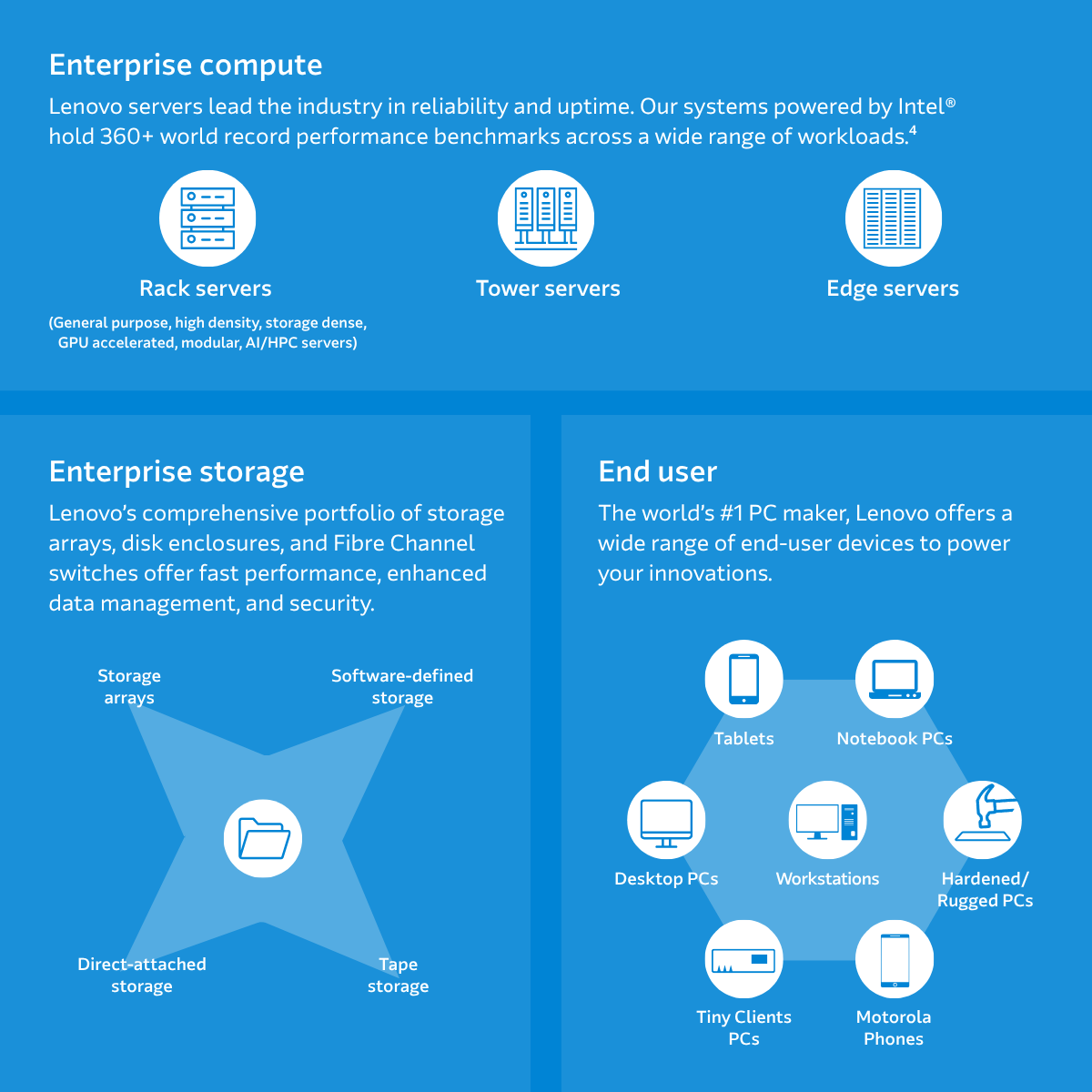 Image: Lenovo OEM Portfolio[/caption]
Whether building infrastructure appliances, edge solutions, AI-enabled platforms, retail systems, healthcare devices, industrial workstations, or validated software-defined solutions, organizations can use Lenovo platforms to align infrastructure choices with workload, configuration, and lifecycle requirements.
How Arrow Electronics Helps Turn Planning into Execution
Supply chain considerations are expected to remain a factor in infrastructure planning, but organizations can take steps to improve visibility, reduce complexity, and prepare for changing conditions.
Arrow helps customers move from strategy to execution by connecting Lenovo’s supply chain strength and infrastructure portfolio with Arrow’s engineering, integration, supply chain, and deployment expertise. This support can help technology solution providers evaluate platform options, understand timing considerations, and align deployment plans with availability, configuration, and business requirements.
Through integration services, testing capabilities, global support, and supplier relationships, Arrow helps organizations source, configure, manufacture, and deploy infrastructure solutions more efficiently.
Together, Lenovo and Arrow help enable organizations with a more resilient route to plan, integrate, and scale solutions across enterprise, edge, and end-user environments.
Connect with Arrow to learn how Lenovo OEM Solutions and Arrow integration services can help you integrate and scale deployment-ready solutions from edge to enterprise.
Explore how Arrow helps support leading OEMs with:

AI Has Entered Its Infrastructure Era: Key Takeaways from Dell Tech World 2026
June 2026
Flying into Las Vegas for Dell Tech World this year felt like an adventure.
The winds were howling, the plane dipped and swayed, while palm trees along the strip bent in ways that seemed to mirror the excitement and anticipation of the week ahead.
It was one of those arrivals where you assume the week ahead might be equally turbulent.
And then, as quickly as the turbulence started, it was no longer.
Eventually, the winds died down, the skies cleared, and Vegas settled into one of those beautifully calm desert weeks. Inside Dell Technologies World, the conversation was just as steady, intentional, and grounded as the flights out of Harry Reid the day before.
While the arrival was chaotic, Dell’s message was anything but. The mantra guiding the week pointed towards a new era: AI has moved from experimentation to infrastructure, and the industry is ready to build on it, spanning from the desktop to the datacenter.
Into the Limelight
One of the clearest signals from the week was that AI is no longer being framed as a bolt-on capability or an isolated innovation project. It’s infrastructure now, and that distinction matters.
What’s important to note is that when something becomes infrastructure, the expectations of the adopters change: reliability and security are assumed and non-negotiable. And seemingly boring things like TCO and lifecycle management take the place of the “Marvel and Gasp” effect AI once had.
This is especially true for OEMs, ISVs, and solution builders, where infrastructure decisions directly influence what you can productize, how you scale, and the sustainability of your solution over time. And Dell’s messaging reflected that maturity. Less hype, more "here’s how this actually works in production."
Desktop to Datacenter
Another theme that resonated strongly was placement. AI isn’t a single-location workload anymore. It doesn’t live exclusively in hyperscale clouds, nor is it simply a pocket assistant on a mobile app. In fact, the reality is quite simple (and boring). AI as infrastructure is as commonplace as water, power, and the internet.
For solution builders, this shift to utility is exciting. It opens the door for everyone to design purpose-built systems–desktop, edge, or rack-scale–that align to specific outcomes rather than generic architectures.
This is where relationships like the one between Arrow and Dell shine, and that message was clear as Arrow’s intelligent solutions business was recognized as both the 2026 OEM Partner of the Year America and the 2026 OEM Marketing Partner of the Year.
This current environment is where integrators like Arrow do their best work: taking components, software, and intent, and turning them into validated, branded, deployable systems that OEM customers can deliver.
 Image: Arrow's intelligent solutions business wins 2026 OEM Partner of the Year America and the 2026 OEM Marketing Partner of the Year at Dell Tech World 2026
The Real Headwinds: Allocation and Scarcity
While the weather eventually calmed down as the conference kicked off, discussions about industry headwinds did not, and Dell didn’t pretend otherwise, echoing the same sentiment as the rest of the industry.
AI infrastructure lives in the real world, which also means even the best solutions are shaped by availability and constraints. Components like memory, drives, and GPUs can make or break a successful deployment. The clear emphasis at the event was that planning and lifecycle management have never been more critical for OEMs and ISVs. And contingency and succession planning MUST be top of mind for the product and engineering teams behind their IP.
The fact that AI is "market-ready" just as the very technology that drives it has hit demand constraints is an undeniable indicator of scale. What stood out the most was the acknowledgment that good architecture and reliable collaborations matter now more than ever under these conditions. In short, AI infrastructure must be resilient not just to failure but also to scarcity.
To echo my previous point, this is exactly where ecosystem partners like Dell and Arrow shine, especially when they work together.
Closing Thoughts
The winds on arrival were dramatic, but brief. What followed was a calm, focused week with a clear message: AI is real. And while it’s settling into its role as infrastructure, from desktop to datacenter, it is equally shaped by real-world constraints and real customer needs. AI’s early chaos, rapid innovation, supply constraints, shifting architectures, will, with the right strategy and collaborations, give way to something more stable and intentional.
Here's to smoother deployments ahead. We’d love to connect with you at Dell Tech World 2027!