

With the rapid development of innovative technologies such as Vehicle-to-Everything (V2X), advanced infotainment systems, and autonomous driving, the automotive industry is undergoing rapid transformation. These technological advancements require connectivity solutions that achieve high-speed data transmission, multi-protocol capability, and effective electromagnetic interference (EMI) suppression within compact and lightweight designs. This article will introduce how to achieve smarter and safer automotive connectivity, and how connected vehicle solutions from Molex help optimize vehicle architecture and enhance user experience, setting new benchmarks for integration and performance.
Connectors: The Bridge for Automotive Electronic and Electrical Systems
In automotive applications, connectors play a crucial role as the bridge between the vehicle's electronic and electrical systems, ensuring stable transmission of signals and power under various harsh conditions. With the development of automotive electrification, intelligence, and new energy vehicles, the importance of connectors has become even more prominent.
Connectors in automobiles are commonly used for power transmission, providing stable power delivery to devices such as Electronic Control Units (ECUs), sensors, actuators, lighting, motors, and batteries. In new energy vehicles, connectors must also withstand high-voltage (e.g., 400V/800V systems) and high currents, ensuring safe and efficient energy transfer.
Furthermore, connectors are used for signal transmission. In Advanced Driver-Assistance Systems (ADAS), autonomous driving, in-vehicle entertainment, and connected vehicles, connectors are responsible for the reliable transmission of high-speed data (CAN, LIN, Ethernet, FlexRay, etc.). High-speed connectors must feature low signal loss and effective EMI suppression to prevent data distortion. Connectors also play the key role in integrating modules and systems throughout the vehicle, enabling seamless interconnection of subsystems, including powertrain, chassis control, body electronics, and in-vehicle infotainment systems. This integration supports easier maintenance and replacement, and enhancing system scalability and modular design efficiency.
Connectors play a significant role in safety. High-quality connectors can prevent system failures caused by poor contact or short circuits, which is crucial for driving safety. For high-voltage electric vehicle applications, connectors require anti-sparking, anti-arcing, and high-insulation design to ensure the safety of personnel and vehicles.
Finally, connectors must provide exceptional reliability. They are engineered to withstand extremely harsh environments – ranging from high and low temperature, humidity, vibration, dust, and salt spray. Connectors need features such as corrosion resistance, vibration resistance, waterproofing (e.g., IP67/IP68 ratings) to ensure long-term stable operation. Additionally, modern connectors must also support high-performance and intelligence applications, offering low-latency, high-bandwidth transmission capabilities for high-speed data exchange (such as image/radar signals from autonomous driving sensors). For applications like fast and ultra-fast charging in new energy vehicles, connectors must withstand currents of hundreds of amperes to improve charging efficiency.

Connected Vehicle Solutions Supporting Faster Data Processing, Stronger Interoperability, and Scalable Architectures
With the expansion of 5G, artificial intelligence (AI), and the Internet of Things (IoT), new possibilities are emerging for connected vehicles. Drivers' expectations for in-vehicle digital experiences are gradually aligning with those for smartphones and smart home devices, raising standards for infotainment systems, navigation, V2X capabilities, and advanced safety features. Integrating these functions into increasingly complex vehicle platforms presents new challenges in data flow management, system compatibility, physical space layout, and real-time performance. To address these demands, automakers are turning to new design strategies and adopting solutions that support faster data processing, stronger interoperability, and scalable architecture.
Molex provides high-speed systems exceeding 20Gbps through multi-protocols such as Ethernet, USB, and LVDS, along with compact EMI-shielded connectors that enhance performance in space-constrained environments. These solutions support robust communication and control, helping automakers meet the critical demands of the connected vehicle ecosystem, supporting faster data, modularity, and the scalable infrastructure needed for zonal and software-defined platforms. Featured products include MX-DaSH Connectors, DuraClik Connectors, High-Speed FAKRA-Mini Interconnect System, and ConnTAK50 Connectors.
Modern vehicles rely on antennas to achieve seamless connectivity to cellular networks, Wi-Fi, GPS, and V2X systems. Achieving optimal performance requires a careful balance of precise antenna placement, interference suppression, and simultaneous multi-protocol supports, while flexibly meeting aesthetic and aerodynamic requirements. Molex provides customizable antenna solutions with integrated processing capability, wide frequency coverage, and aesthetic flexibility, ensuring stable, high-performance in-vehicle network connectivity and design harmony.
Advanced Driver-Assistance Systems (ADAS) utilize camera fusion technology to deliver features such as 360-degree surround view, lane departure warning, and pedestrian detection. These systems depend on reliable high-speed connections between sensors, cameras, and control modules to operate. Integrating them into connected vehicle platforms faces challenges in data traffic management, latency minimization, and long-term reliability. Molex stAK50h Connector System provides a modular, high-performance solution that enhances data integrity and improves ADAS performance in harsh automotive environments, thereby improving safety and efficiency.
On the other hand, convergence applications including ADAS, infotainment systems, and V2X systems require fast and reliable connections within increasingly compact electronic architectures. These designs must deliver high-speed data and power transmission while withstanding vibration, extreme temperatures, and environmental exposure. The Molex HSAutoLink C Interconnect System meets these requirements with a durable USB Type-C interface, supporting data transmission up to 40Gbps and power delivery up to 240W. This ensures stable performance in harsh automotive environments.

Helping Automotive Designers Meet the New Hardware Requirements of Zonal Gateway Design
Zonal gateways are instrumental in expanding vehicle electronic systems. Zonal gateway designers require reliable and durable solutions to deliver the necessary bandwidth and speed, paving the way for lighter and more efficient vehicles. Molex leverages rugged, high-quality automotive connectors to transmit power, signals, and data, driving the transformation to zonal architecture.
Molex supports automotive designers to meet the new hardware requirements of zonal gateway design. In domain-based vehicle architectures, each Electronic Control Unit (ECU) is dedicated to a specific function, such as powertrain, chassis, or infotainment. However, zonal architecture requires each gateway to serve as a versatile control unit to manage multiple systems located nearby. Through decades of collaboration with automakers in design, engineering, and manufacturing, Molex has developed best practices for rugged and long-lasting vehicle interconnection solutions, equipped with precision terminals and mating mechanisms that are easy to assemble and maintain.
Zonal architecture supports modularity and enables advanced automotive high-speed data processing. These important innovations help alleviate the space constraints for zonal gateway designers and provide the data speed required for real-time monitoring and control. Molex provides a range of connectivity solutions that enable high-performance inside-the-box functionality for zonal gateways. Wire-to-board and board-to-board interconnect products support high-speed data transmission up to 224Gbps, address miniaturization challenges, and provide rugged and reliable performance, helping to realize the next generation of vehicle electronics architecture.
Molex also provides external connectors for zonal gateway connectors. These products can help designers extend signals, power, and data from zonal gateways to a wider range of automotive subsystems. These rugged, automotive-ready solutions meet stringent standards for vibration and temperature performance and support the transition to 48V wiring architecture. High-speed connectivity technology from Molex supports signal, power, and high-speed data transmission, helping to reduce wiring harness complexity and shorten integration time for applications such as infotainment, telematics, and automotive zonal architecture. These interconnect solutions meet automotive standards for reliable performance in harsh environments.
Connector System Integrating High-Speed Data, Signal, and Power Together
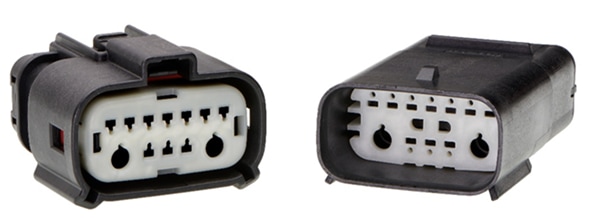
This article specifically introduces the MX-DaSH (Molex Data-Signal Hybrid) Connector System, which integrates high-speed data, signals, and power into one connector, enabling replacement of multiple traditional connectors in vehicle applications. By optimizing packaging, the MX-DaSH Connector helps reduce weight, minimize size, lower cost requirements, simplify assembly operations, and support the transition to zonal architecture.
Today's high-speed data connections predominantly use single-circuit connectors packaged alongside power and signal connections. The MX-DaSH Connector integrates high-speed data, traditional power, and signal circuits into a single connection system, reducing the need for additional single-circuit connections and lowering the cost of the entire electrical system. The MX-DaSH wire-to-board connector portfolio provides designers with flexibility and the ability to consolidate multiple connectors into one, enabling optimized wiring layout and manufacturability. This represents a new approach to optimizing the vehicle wire harness for weight and cost savings.
As automotive design evolves toward zonal architecture, engineers will need connectivity solutions that can manage multiple interfaces and functions in limited space. The MX-DaSH Connector System is designed to meet zonal architecture requirements and the need for compact connectivity to an electronic control unit (ECU) and computer. These important design features ensure a consistent connection every time. MX-DaSH wire-to-wire products utilize industry-leading high-stability male blade stabilization and independent secondary locks to ensure proper terminals mating.
In terms of wire-to-wire solutions, each MX-DaSH connector incorporates more functions. This enables optimized wiring harness designs to support an increasing number of devices such as cameras, radar, turn signals, and mirror defrosters, while simplifying harness installation and reducing connection points.
Molex wire-to-board MX-DaSH connector solutions are well-suited for in-cabin zonal controllers and high-performance computers, providing modular capability that allows flexible adjustment of the connector to adapt to the desired content. The same form factor can be used across multiple automotive platforms, reducing complexity and validation time.
MX-DaSH optimizes the wiring harness by integrating multiple connectors into one, incorporating power, signal, and data connections using 0.50, 1.20, 1.50, 2.80, or 4.80mm terminals, as well as High-Speed FAKRA-Mini (HFM) coaxial cables for data transmission. It provides T2/V1/S3-rated sealing and mat seal for reliable operation in harsh conditions, eliminates the need for individual cable seals, reduces package size, lowers the cost of connectors used in harsh environments, and ensures secure mating and reliable connectivity. It offers features such as independent secondary lock (ISL), pin protection plate (PPP), and blade protection; simplifies implementation and integration into designs; minimizes assembly options by using complete assemblies for male and female housings; prevents mis-mating; minimizes assembly errors; and uses six unique keyways to ensure proper orientation. Additionally, it offers a choice of sealed and unsealed connectors, combining multiple circuit counts and power/signal combinations to provide compact hybrid connectivity for various automotive applications requiring high-speed signal transmission in in-cable and I/O applications.
Conclusion
As vehicles continue to evolve toward more intelligence and connectivity, connectors and connectivity solutions have become the key fundamental element driving industry advancement. From high-speed data transmission to high-voltage power supply, reliable connectivity not only guarantees vehicle safety and performance but also lays a solid foundation for innovative applications such as autonomous driving, V2X, and smart cockpits. This article demonstrates how advanced, miniaturized, and more environmentally adaptive connection technologies and products from Molex will enable true automotive intelligent connectivity, making the mobility experience safer, smarter, and more convenient for everyone.