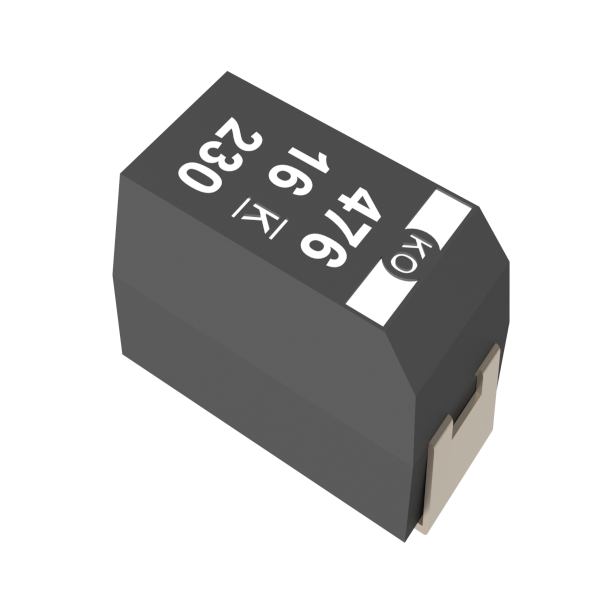

KEMET CorporationT520H827M010ATE070 | T520 Standard Tantalum Polymer Capacitor SeriesCapacitor Tantalum Polymer
Cap Tant Polymer 820uF 10VDC H CASE 20%( 7.3 X 6 X 1.9mm) Inward L SMD 7360-20 0.07 Ohm 85°C T/R
KEMET Organic Capacitors (KO-CAP®) are solid electrolytic capacitors with a conductive polymer cathode, capable of delivering very low ESR and improved capacitance retention at high frequencies. KO-CAP combines the low ESR of the multilayer ceramic, the high capacitance of aluminum electrolytic, and the volumetric efficiency of tantalum into a single surface mount package. These devices offer full AEC-Q200 qualification and allow automotive segment designers to take advantage of the polymer technology.
The KEMET Organic Capacitor (KO-CAP) is a solid electrolytic capacitor with a conductive polymer cathode capable of delivering very low ESR and improved capacitance retention at high frequencies. KO-CAP combines the low ESR of multilayer ceramic, the high capacitance of aluminum electrolytic, and the volumetric efficiency of tantalum into a single surface mount package. Unlike liquid electrolyte-based capacitors, KO-CAP has a very long operational life and high ripple current capabilities. The T52X/T530 provides the widest range of voltages, capacitance and case size options in the KO-CAP family and is suitable for general purpose DC applications for up to 48 volt DC voltage rails.
Datasheet
T520 Datasheet| Compliant | |
| EAR99 | |
| Active | |
| 8532.21.00.50 | |
| Automotive | No |
| PPAP | No |
| Polymer | |
| 820uF | |
| 20% | |
| 10VDC | |
| 0.07 | |
| Very Low | |
| 1.2 | |
| 820 | |
| Polar | |
| 20 | |
| High Frequency|High Ripple Handling|Low ESR | |
| No | |
| Yes | |
| H | |
| Molded | |
| Flat | |
| Surface Mount | |
| Inward L | |
| 2 | |
| 7.3 X 6 X 1.9 | |
| 7360-20 | |
| -55 | |
| 85 | |
| Tape and Reel | |
| 7.3 | |
| 6 | |
| 1.9 | |
| 0.385 |
Design AI-powered medical devices
Explore system design tips, part recs and AI insights to help you build faster, safer diagnostic and therapy solutions—all in Arrow’s latest white paper.