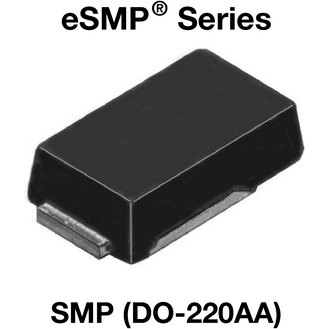

VishaySMP30A-M3/84ATransient Voltage Suppressors (TVS)
Diode TVS Single Uni-Dir 30V 400W 2-Pin SMP T/R
Vishay has introduced the eSMP® (enhanced Surface-Mount Power) series packages for high reliability automotive and industrial applications. The series consists of flat-type surface-mount packages with space-saving footprints that maintain the surge capabilities of traditional transient voltage suppressor (TVS) diode packages. Vishay provides 400 W SMF (DO-219AB), 400 W SMP (DO-220AA), 600 W SlimSMA (DO-221AC), and 1500 W SMPC (TO-277A) TVS for the same 10 / 1000 µs surge conditions as the traditional 400 W SMA, 600 W SMB, and 1500 W SMC TVS packages.
TVS in eSMP® series
Did You Know Infograph
Features
- • AEC-Q100 qualified and Automotive Grade available
- • Low profile MicroSMP package with very low profile height or 0.65 mm
- • Unidirectional polarity only
- • Peak pulse power: 150 W (10 us/1000us)
- • ESD capability: 15 kV (air), 8 kV (contact)
Benefits
Vishay TVS in MicroSMP® package with space-saving footprints that maintain the surge capabilities of traditional transient voltage suppressor (TVS) diode packages. MSMP6.0A thru MSMP20A series, MSP3V3 and MSP5.0A devices provide high surge capability of 150 W at 10/1000 us for portable electronics.
| Compliant with Exemption | |
| EAR99 | |
| Active | |
| 8541.10.00.80 | |
| SVHC | Yes |
| SVHC Exceeds Threshold | Yes |
| Automotive | No |
| PPAP | No |
| Single | |
| Uni-Directional | |
| 1 | |
| 33.3 | |
| 48.4 | |
| 30 | |
| 8.3 | |
| 1 | |
| 1 | |
| 400 | |
| -55 | |
| 150 | |
| Tape and Reel | |
| Mounting | Surface Mount |
| Package Height | 1.15(Max) mm |
| Package Width | 2.18(Max) mm |
| Package Length | 3.61(Max) mm |
| PCB changed | 2 |
| Standard Package Name | DO |
| Supplier Package | SMP |
| 2 | |
| Lead Shape | Flat |
| EDA / CAD Models |
Design AI-powered medical devices
Explore system design tips, part recs and AI insights to help you build faster, safer diagnostic and therapy solutions—all in Arrow’s latest white paper.