

With technological advancements, the future of fully autonomous driving is no longer out of reach. Today, issues related to autonomous driving primarily revolve around the underlying technologies and advancements required to make it a reality. Light Detection and Ranging (LiDAR) technology is one of the most discussed technologies supporting the transition to autonomous driving applications, yet many practical application questions remain. This article explores the uses of LiDAR in autonomous driving system design and related solutions introduced by ADI.
Design requirements for LiDAR in autonomous driving systems
Perceiving the world around us is highly challenging. LiDAR is often used in the design of autonomous driving systems for object detection and classification. Therefore, understanding LiDAR's design requirements will help designers select a safe and cost-effective solution.
Taking a LiDAR system with a range greater than 100 meters and an angular resolution of 0.1° as an example, such a system can be a core module in the autonomous driving field. However, not all autonomous driving applications require this level of performance. Valet parking assistants and street sweeping are two examples that do not necessitate such advanced systems. Currently, numerous depth-sensing technologies can enable these applications, such as radar, stereo vision, ultrasonic detection and ranging, and LiDAR.
However, these sensors represent trade-offs between performance, form factor, and cost. Ultrasonic devices are cost-effective but limited in range, resolution, and dependability. Radar offers significant improvements in detection range and dependability but has limitations in angular resolution. Additionally, stereo vision carries high computational overhead and limited accuracy if not properly calibrated. Well-designed LiDAR systems can compensate for these shortcomings by offering precise depth sensing, fine angular resolution, and low-complexity processing, even over long detection distances. Nonetheless, LiDAR systems are generally perceived as bulky and costly, aspects that still require improvement.
LiDAR system design must determine the system's capability to identifying the smallest object, specifically how far away it can detect object of a certain size with low reflectivity. This also defines the required angular resolution of the system. From this, the minimum achievable Signal-to-Noise Ratio (SNR) can be calculated, which determines the system's probability of detection and false detection rate.
By understanding the required perception environment and the necessary amount of information, appropriate design trade-offs can be made to develop a solution with optimal cost and performance. For example, the performance requirements for LiDAR will differ vastly between an autonomous vehicle traveling at 100 kph (~62 mph) on a road and an autonomous robot moving at 6 kph in a pedestrian zone or warehouse.
Taking the autonomous vehicle as an example, in high-speed scenarios, we might need to consider not only the vehicle moving at 100 kph but also another vehicle approaching at the same speed from the opposite direction. For the sensing system, this is equivalent to an object approaching at a relative speed of 200 kph. Assuming the LiDAR sensor has a maximum detection distance of 200 meters, the distance between the two vehicles would close by 25% in just one second. It is important to note that complexities such as the vehicle's velocity (or the non-linear closing speed relative to the object), stopping distance, and the dynamics involved in performing evasive maneuvers vary with each specific situation. Generally speaking, high-speed applications require LiDAR systems with longer detection ranges.
Resolution is another critical system characteristic in LiDAR design. Fine angular resolution enables the LiDAR system to receive return signals in multiple pixels from a single object. For instance, at a distance of 200 meters, a 1° angular resolution translates to a single pixel width of 3.5 meters. This pixel size is larger than the physical dimensions of many targets, posing several challenges. Firstly, spatial averaging is often used to improve SNR and detectability, but this method is not applicable if the target occupies only one pixel. Furthermore, even if detection occurs, assessing the object's size becomes impossible. A piece of road debris, an animal, a traffic sign, and a motorcycle are typically smaller than 3.5 meters, leading to identification difficulties.
However, if the angular resolution is improved tenfold to 0.1°, five adjacent pixels could be collected horizontally for a car 200 meters away. This means it becomes possible to distinguish between a car and a motorcycle at 200 meters (based on vehicle width, as vehicles are generally wider than they are tall, and cars and motorcycles have similar heights but significantly different widths).
For safe autonomous navigation, high resolution is sometimes needed not only in azimuth but also in elevation. Imagine an autonomous cleaning robot moving slowly but needing to detect narrow yet tall objects like table legs to determine if it can fit underneath for cleaning. This requirement differs significantly from the high-speed autonomous driving needs mentioned earlier.

High-performance LiDAR prototyping platform and development kit
Once the speed and operational scenario of the autonomous device, the nature of the targets to be detected, and the required performance are determined, the LiDAR system architecture suitable for the application can be constructed. Various choices can be made, such as using scanning or flash techniques, Direct Time-of-Flight (ToF) versus waveform digitization, each system architecture having its own advantages and disadvantages. Regardless of the chosen architecture, ADI's extensive portfolio of high-performance signal chain and power management components provides the essential building blocks to help design systems with different constraints, such as form factor and cost.
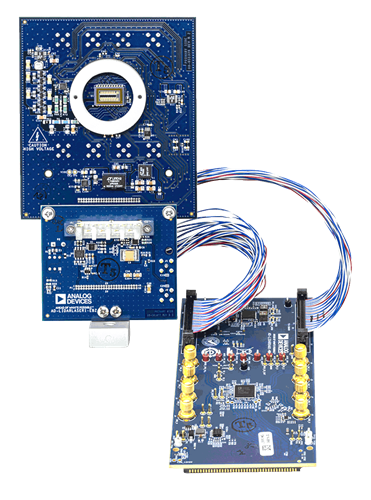
The AD-FMCLIDAR1-EBZ from ADI is a high-performance LiDAR prototyping platform and a 905 nm pulsed direct ToF LiDAR development kit. This system enables rapid prototyping for robots, drones, agricultural and construction equipment, and ADAS/AV applications using a 1D static flash configuration. The components selected for this reference design primarily target long-range pulsed LiDAR applications. The system employs a 905 nm laser source driven by the high-speed, dual 4A MOSFET ADP3634. It also includes a 16-channel APD array from First Sensor, powered by the programmable power supply LT8331, which generates the APD supply voltage. Furthermore, it incorporates multiple low-noise, high-bandwidth 4-channel LTC6561 TIAs and an AD9094 1 GSPS, 8-bit ADC, which boasts low power consumption of 435 mW per channel. The design requires continuous increases in bandwidth and sampling rate to help enhance overall system frame rates and range precision. Simultaneously, minimizing power consumption is crucial as reduced heat dissipation simplifies thermal/mechanical design, thereby aiding in reducing the module's form factor.
Measurement range (or depth) and precision are related to the ADC sampling rate. Range precision allows the system to precisely determine the distance to an object, which is vital for scenarios requiring close-quarters movement, such as parking or warehouse logistics. Additionally, calculating the target's velocity based on the change in range over multiple frames demands even higher range precision.

Highly configurable LiDAR evaluation system
The EVAL-ADAL6110-16, a highly configurable evaluation system, assists in implementing LiDAR system design. It provides a simple yet configurable 2D flash LiDAR depth sensor for applications requiring real-time (65 Hz) object detection/tracking, such as collision avoidance, altitude monitoring, and soft landing.
The optics used in this reference design provide a Field of View (FOV) of 37° (azimuth) by 5.7° (elevation). In the 16-pixel linear array oriented in azimuth, the pixel size at 20 meters is comparable to an average adult's size, 0.8 meters (azimuth) x 2 meters (elevation). As mentioned earlier, different applications may require different optical configurations. If the existing optics do not meet the application needs, the printed circuit board can be easily removed from the housing and integrated into a new optical configuration.
The system software enables fast ranging for multi-point measurements. Its channels are completely independent, operating from a single 5 V supply provided via USB. It can be easily integrated into existing autonomous systems using the provided Robot Operating System (ROS) drivers. Users only need to create a connector header to interface the device with their robot or vehicle and communicate via one of four available communication protocols: SPI, USB, CAN, or RS-232. Furthermore, the reference design can be modified using different receiver and emitter technologies.
The AD-FMCLIDAR1-EBZ LiDAR development module hardware platform flexibly meets individualized design needs, shortens time-to-market, and reduces the complexity of LiDAR development. It includes an open-source software framework integrable into customer designs, along with wrappers for Matlab and Python. When paired with an FPGA via the FMC connector, it can be used for LiDAR software and algorithm development. While developing software and algorithms, the hardware design can be leveraged for productization. Depending on customer preferences and development experience, different FPGA development platforms can be used, such as the Intel Arria10 SoC and Xilinx ZC706 development platforms used to test this system. The AD-FMCLIDAR1-EBZ finds applications in ADAS, drones/UAVs, robotics, industrial automation, and SLAM (Simultaneous Localization and Mapping).
Signal processor meeting LiDAR application requirements
This evaluation system is centered around ADI's ADAL6110-16, a low-power, 16-channel integrated LiDAR Signal Processor (LSP). This device provides timing control for illuminating the field of interest, the timing to sample the received waveform, and the capability to digitize the captured waveform. The integration of sensitive analog nodes in the ADAL6110-16 helps reduce the noise floor, enabling the system to capture very low-energy return signals. Compared to discrete component solutions with similar signal chain parameters, where the RMS noise often dictates the noise floor, the sensitivity of discrete approaches is generally inferior to the ADAL6110's solution. Moreover, using an integrated signal chain helps reduce the size, weight, and power consumption of the LiDAR system design.
The ADAL6110-16, a 16-channel LiDAR signal processor, integrates a 16-bit Analog-to-Digital Converter (ADC) in each channel to measure the optical return signal. The ADAL6110-16 stores the captured waveforms in Static Random-Access Memory (SRAM). Data output readout and functional configuration of the LiDAR signal processor are performed via a 4-wire Serial Peripheral Interface (SPI).
This LiDAR signal processor features DC balance control to reject signal offset and corruption caused by modulated interference, eliminating the need for external DC cancellation circuitry. Additionally, it incorporates a built-in Automatic Gain Control (AGC) function that automatically adjusts the system gain to ensure the signal of interest is scaled appropriately within the measurement range.
The ADAL6110-16 simplifies the implementation of traditional multi-channel LiDAR systems by integrating the Transimpedance Amplifier (TIA), gain and sampling stage, and providing the transmitter fire signal, all managed by on-chip control logic. No external components are required between the photodiodes and the TIA interface of each channel in the LiDAR signal processor. The ADAL6110-16 is applicable in areas such as autonomous system collision avoidance, corridor mapping, dynamic suspension and flight control, drone altitude monitoring, industrial distance measurement, mounted safety curtain systems, parking spot monitoring, and blind spot detection.
Conclusion
In autonomous driving system design, LiDAR technology, with its high-precision 3D sensing capability, has become one of the key cores for achieving environmental understanding and safe decision-making. With the ongoing development of chip integration, solid-state technology, and algorithm optimization, LiDAR can not only provide reliable data support in complex environments but also fuse with multiple sensors like cameras and radar to achieve more robust perception solutions. The LiDAR solutions introduced by ADI are poised to play a broader role in the various levels of autonomous driving applications developed by customers, serving as a crucial foundation for advancing intelligent transportation and smart mobility.