Panasonic EV charging solutions

Autos aren’t as simple as they used to be. Instead of 4 wheels, a carburetor, a transmission and an AM/FM radio (if you were lucky), modern cars have complex electronic designs with numerous systems that need to communicate. The more highly integrated these systems are, the better performance and ease of use they’ll provide. This article explores Panasonic wireless modules, passives, Emech components and thermal management solutions for EV applications.
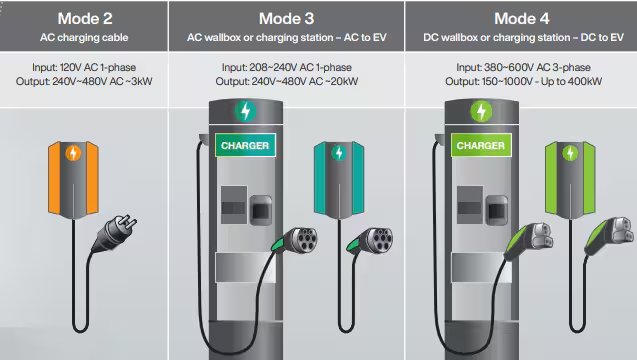
Panasonic EV charging solutions: EV charging types and requirements
“Panasonic’s mission: Zero failure”
Safe, fast & reliable charging – the key driver for successful e-mobility
E-mobility is part of Panasonic’s DNA. For decades, Panasonic has developed and supplied solutions for all kinds of EVs. To succeed in the mass market, the new technology must be reliable. Customers will not accept failures, neither during driving nor during charging. This zero-failure mindset provides motivation to engineer best-in-class components & devices for safe, fast & reliable charging technology.

Wireless modules: Combination of Wi-Fi and Bluetooth®
“The PAN902x Series perfectly connects the charging station with mobile devices or a cloud.”
Wireless modules serve as access points or clients for commissioning and displaying usage data by a smartphone or similar handset. With its combination of Wi-Fi and Bluetooth® functions, the PAN902x Series provides the highest flexibility for connectivity, depending on which data rates or ranges are required for an EV charger application. The PAN9028, a dual-band Wi-Fi 5 radio module with additional Bluetooth and its integrated antenna, is specifically designed for highly integrated and cost-effective applications. In contrast, the Wi-Fi 6 & Bluetooth combo module PAN9019 is targeted for more sophisticated use cases where higher data rates (802.11ax) are needed. With the PAN9019A, you can connect your chargers to a mesh network via Thread and Zigbee, thanks to the additional 802.15.4 radio. The PAN902x can act as a client to connect the charging station to a network in order to upload data to a cloud.


Wireless modules: Bluetooth® LE solution
“Integrate the PAN178x series in a meshed network and easily access charging station data."
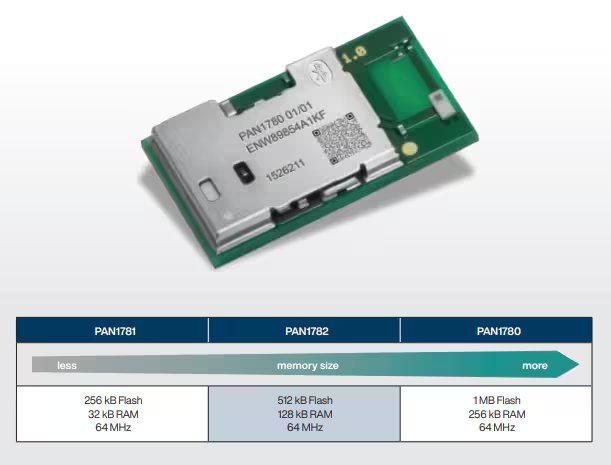
PAN178x are Bluetooth® 5.3 Low Energy modules with additional 802.15.4 radio based on Nordic Semiconductor chipsets, particularly suitable for low-power transmission of smaller data rates. The wireless modules differ only in memory size and number of GPIOs to meet various application requirements. In commercial DC charging stations, the PAN178x modules can be integrated into a meshed network, which gives the operator an overview of the individual charging stations in terms of occupation and thus also allow dynamic load balancing. The PAN1780 in particular offers full flexibility to choose the appropriate mesh protocol, such as Thread, Zigbee or Bluetooth Mesh.

PAN178x
- IP Core: Cortex M4(F) with 64 MHz
- Temperature Range: -40 to 85
- Size: 15.6x8.7x2mm
- Up to 48 General Purpose I/Os (depending on module version)
Polymer capacitors: Perfect for AC/DC and DC/DC converters
“Tough against temperature fluctuations, perfect for outdoor installations.”
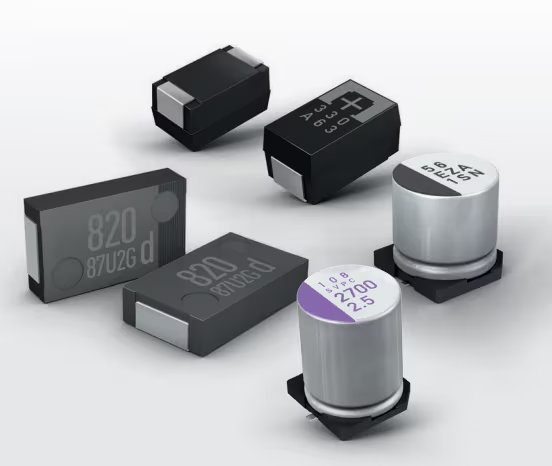
These advanced capacitors use conductive polymers to form the electrolyte, or the conductive polymers can be used in conjunction with a liquid electrolyte in a design known as a hybrid capacitor. Either way, these polymer-based capacitors fulfill the high endurance and temperature requirements of EV charging stations. In addition, due to polymerization and having high conductivity, such applications benefit from a very low ESR which is needed for power stabilization.
- Ultra-low ESR for power stabilization (down to 3mΩ)
- Long endurance at high temperature, 20,000h @105°
- High reliability for outdoor usage
- AEC-Q200 compliant
- High temperature resistance up to 150°C

Film capacitors: Automotive film capacitors up to 125°C integrated with fuse function for higher safety
“Zero risk for safety and high resistance against moisture.”
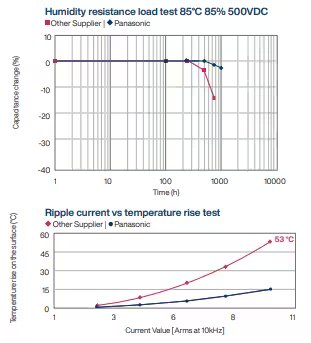
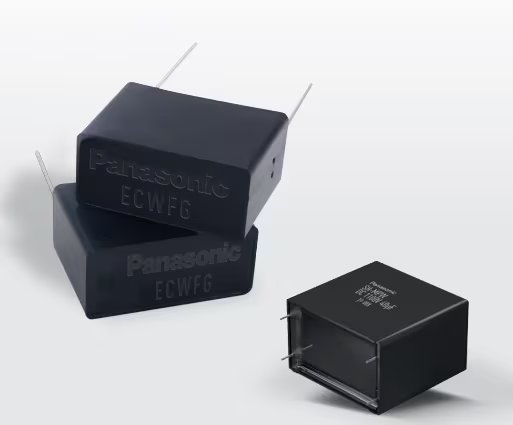
The outstanding features of the film capacitor are the high ripple current (up to 30A) and high humidity resistance. This is achieved by using special vacuum-controlled sealing technology, which prohibits moisture from settling on the film, thereby making Panasonic film caps more reliable. In addition, Panasonic‘s film capacitors also have the original in-house patterned metalization process, which serves as a fuse function for extra added safety.
- DC film capacitors: ECWFG/EZPV
- Rated voltage: Up to 1100VDC
- Temperature: Up to 125°C
- Capacitance: Up to 110uF
- Self healing + fuse function for higher safety standards
- High moisture resistance 85%, 85°C, 1000h
- Flame-retardant plastic casing
Power inductors: Metal composite magnetic core technology for outstanding reliability
“Space-saving high-quality design with zero failures.”
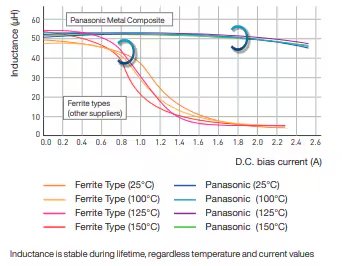
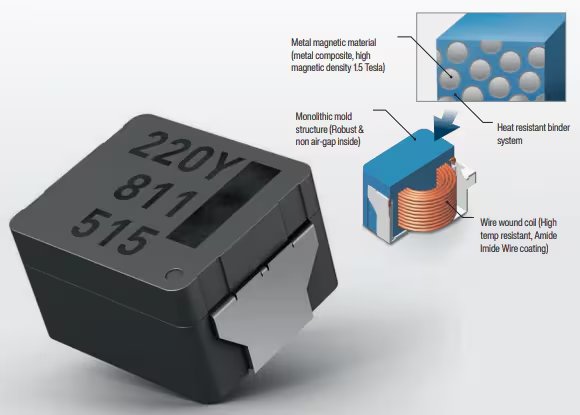
ETQP power inductors series give best-in class reliability for the automotive industry market. The monolithic core and innovative terminal structure guarantee high resistance against thermal stress and vibrations. Unique is the magnetic core material which provides non-hard saturation characteristics against D.C. bias current for high peak current capability, and also can reduce D.C. Resistance and A.C. Resistance for low power loss. This, in turn, supports higher power efficiency in DC-DC converters and input filter circuits, as well as a possible space reduction of up to 50% versus ferrite inductors.
- Variety of inductance range from 0.33µH to 100µH
- Package size from 5x5mm to 12x12mm
- Up to 85A saturation, 53A rated / 0.33µH
- Operation temp. -55°C to +155°C, up to +180°C in short time
- Up to 50% space saving vs ferrite
- Vibration resistance from 10G to 30G
- AEC-Q200 compliant
- Operations voltage up to 70 V
Chip resistors: Enhancing solder joint reliability by soft termination
“Panasonic’s mission: Zero solder joint cracks.”
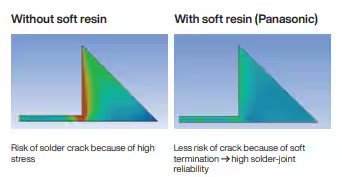
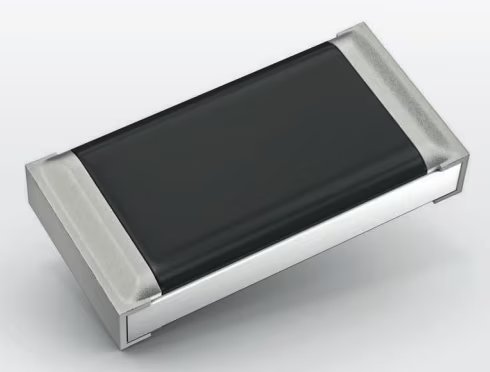
Panasonic offers a wide range of resistors designed and tested for various applications. All Panasonic resistors use soft termination technology. This means that by using a soft resin, the solder joint experiences less stress in temperature cycles and, therefore, ensures a minimum risk of solder joint cracks.
EV Charging – recommended series
- High-temperature thick film chip resistors (ERJH series)
- Anti-surge thick film chip resistors (ERJP series)
- High power wide terminal thick film chip resistors (ERJB and ERJD series)
- Soft termination technology for the highest solder-joint reliability
- Resistance values from 1 mΩ to 10 MΩ
- High power series available up to 2W
- High temperature up to 175°C, 100% rated power up to 105°C
- Anti-pulse and anti-sulfur types available
- AEC-Q200, RoHS, and REACH compliant
Relays as a main switching element: Handle up to 22kW of charging power directly on the PCB
“Get ready for maximum charging power and use HE-R relays for 3-phase systems for direct PCB mounting.”
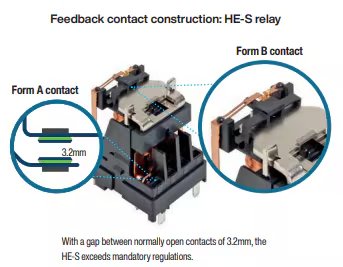
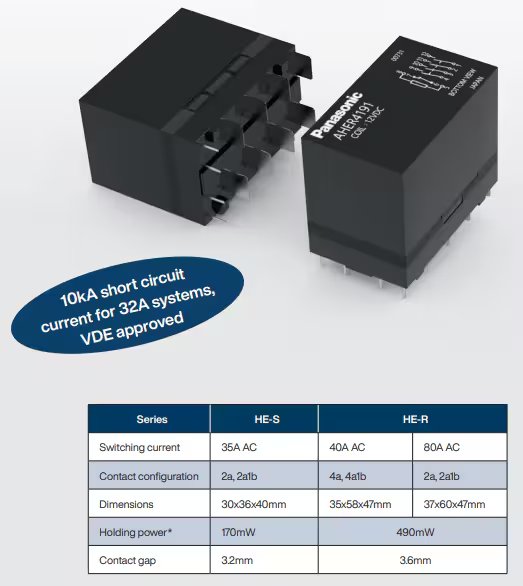
AC switching elements are crucial for safety and protection in charging stations and cables. Key parts of the HE line-up are the 35A HE-S or 80A HE-R relay with two contacts and the 40A HE-R relay with four contacts. All types are available with a mirror contact according to IEC 60947- 1 and VDE / UL approvals. They can be used in the latest generation of wallboxes, which fulfill either IEC 61851-1 or the recent IEC 62955 norm.
Relays for control side: Galvanic isolated relays for signaling and locking
“Realize an isolation of 1,500V in a small SOP6 housing.”
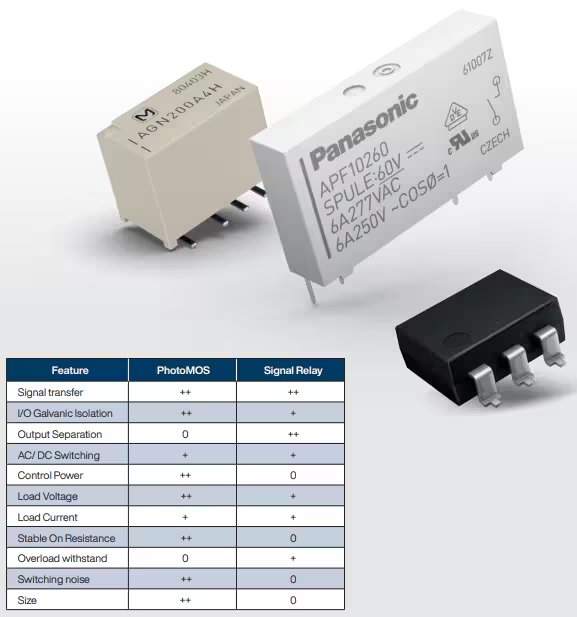
Besides the power line, charging stations include many systems for communication, system control, safety functions and HMI. Wherever switching must be electrically separated from the control circuit, electromechanical or optocoupled semiconductor PhotoMOS® relays are used. The AQY series, for example, is used in charging station battery storage systems to isolate internal from external signals. Contact Panasonic directly to find the perfect fit for your need quickly – and save hours of internet investigation.
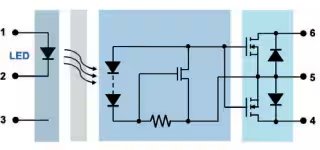
PhotoMOS® relays realize galvanic isolation by an LED that emits light through an isolator to a solar cell. The solar cell drives the MOSFET output.
Graphite thermal interface material: Extend product lifetime with high-reliability properties
“Just apply and get long-term reliability benefits.”
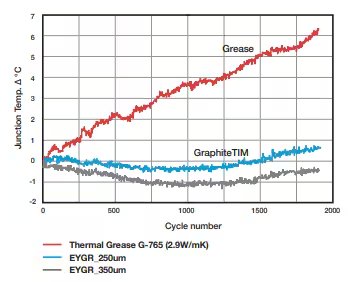
GraphiteTIM, a Panasonic-exclusive material using highly crystallized graphite, transfers heat generated from a power device to a heat sink with excellent thermal conductivity. In addition, the high compressibility effectively fills the voids between the heating and the cooling device to achieve even lower thermal resistance. Compared to grease, GraphiteTIM has stable heat dissipation for a long period of time due to no deterioration and pump-out effect. It provides high reliability in power cycle tests because junction temperature remains stable for a long period of time.
- Low thermal resistance (ASTM D5470 at 0.6MPa) 0.2 K • cm2/W*
- High Compressibility (ASTM D5470 at 0.6MPa) 40%*
- High reliability (stable juntion temperature)
- Operating temperature -55 to +400 ºC
- Easy handling and easy to install

Convenient operation and connectivity for end users and manufacturers
“Human-machine interface, PLC, and industrial communicator as perfect matches to connect your charging infrastructure.”
Panasonic Industry offers a wide portfolio of industrial automation devices. For the particular use in an EV charging infrastructure the Human Machine Interface (HMI) HMx700, the PLC FP0H, and the Industrial Communicator FP-I4C can be of great advantage. The HMx700 is a high-end but nevertheless robust touch panel which allows an easy operation of the charging station. With its small footprint, the PLC FP0H fits perfectly in narrow places. Even though of its compactness this programmable logic controller convinces with its connectivity and performance. The collection and secure transfer of data is crucial for all applications. For this case, the Industrial Communicator is the perfect choice: Literally endless connectivity with multiple communication languages.
FPOH
- Fast processing with 10ns per step
- Very compact footprint
- Excellent connectivity with two Ethernet ports and an internal switch
HMx700
- Capacitive glass touch panel
- UV and scratch-resistant
- Operation temperature -20 to +60°C
FP-I4C
- Collecting and transferring data
- Connect directly to SQL databases or other systems
- Sophisticated secure protocols: HTTPS, VPN, SSH, FTPS, SSL/TLS
Article Tags